
Monday - September 14th
12:00 PM - 2:15 PM
Keynote Luncheon
We Rise Together, So We Don't Go Back
Richard Prangley and Manfred Tatzman
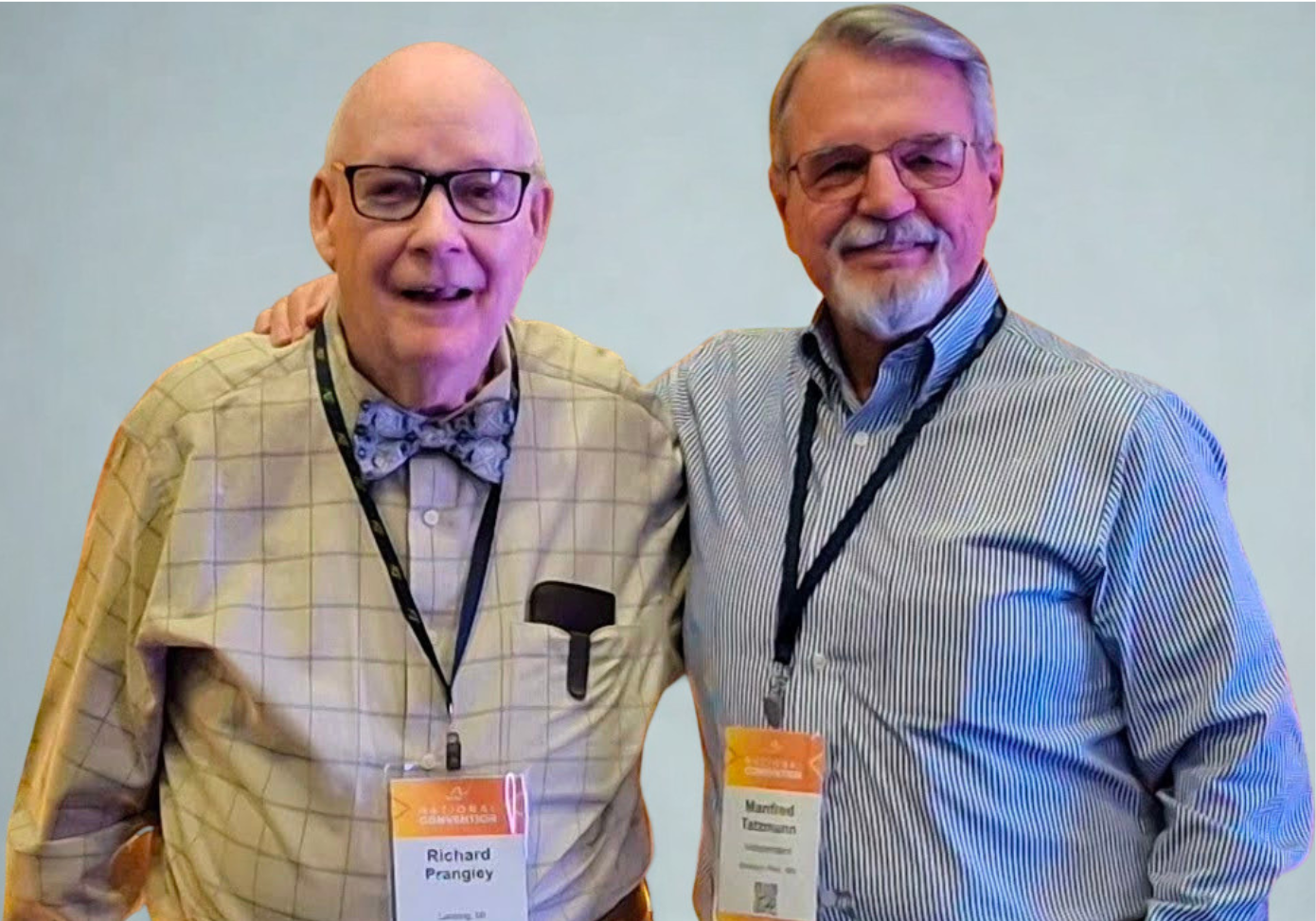
The disability rights movement has transformed what is possible for people with developmental disabilities. We once were separated from each other. Since then, we have been on the path towards belonging, choice, relationships, work, home, and opportunity. But that progress did not happen on its own, and it cannot be taken for granted.
Richard Prangley spent much of his childhood and young adulthood living in a large institution before leaving in 1972. He went on to build a life in the community as an advocate, employee, homeowner, and friend. Together with his longtime friend and fellow advocate Manfred Tatzmann, Richard will share his story and reflect on the movement that helped move our country away from institutionalization and toward community living.
Their story will lead us into a conversation across generations and experiences about what community living means today, including voices from a generation that has grown up expecting nothing less community life. People with developmental disabilities and families will share what life in the community look like for them.
We Rise Together is both a celebration of how far we have come and a call to protect that progress. We honor those who fought to get us here, listen to the people living this work today, and recommit ourselves to a future where every person with a developmental disability has the opportunity to build a life in the community they choose.
We know where we have been. We know what is possible. And together, we are not going back.
As you scroll through the sessions below, click on the session title to see detailed descriptions!
Saving Beyond Barriers , An Introduction to ABLEnow with Brittany Bullock
More independence, greater financial security and an improved quality of life—that’s the future ABLEnow is helping to build. Discover how ABLEnow accounts can help individuals with disabilities save for the future without jeopardizing eligibility for critical benefits. This session will provide an overview of ABLEnow’s features, eligibility requirements and the advantages of tax-advantaged savings. We will also cover recent updates to ABLEnow, including expanded contribution limits, enhanced online tools and new options that make managing your account easier than ever. Whether you’re opening an account for yourself or assisting someone you care about, this session will equip you with the knowledge to make informed decisions.
The CARE Method™: Navigating Complex Care Systems with Confidence with Tiffany Ferrell
Families supporting loved ones with intellectual and developmental disabilities often find themselves navigating healthcare systems, educational services, community resources, and support programs simultaneously. The complexity can leave caregivers feeling overwhelmed, unorganized, and unsure of their next steps.
This interactive workshop introduces the CARE Method™, a practical framework designed to help families move from confusion to confidence. Participants will learn strategies for organizing critical information, communicating effectively with providers, preparing for appointments and meetings, accessing resources, and advocating with greater clarity and confidence.
Drawing from my lived caregiving experience and professional caregiver advocacy work, this session provides actionable tools that attendees can immediately implement in their daily lives. Participants will leave with practical strategies, increased confidence, and a roadmap for navigating complex care and disability systems while supporting their loved ones with greater purpose and peace of mind.
From School to Work: Pre-ETS in Action with Jennifer & Cassie Brown
Learn how Pre-Employment Transition Services (Pre-ETS) can help students with disabilities explore careers, build workplace skills, and gain real-world experience before leaving high school. Community Knights will share how its READY Program connects students with local businesses for job exploration, internships, and work experiences, with individualized support and transportation to help remove barriers to participation.
Belonging as Protection: Preventing Abuse Through Inclusion with Laura Bennett
What if the most powerful tool for preventing abuse isn't a policy or a background check, but a program where you're known by name, expected each week, and missed when you're gone? Youth with developmental disabilities are three times more likely to experience abuse, yet most prevention work leaves them out. This session shows how belonging itself becomes protection, and how consent, communication, and body autonomy can be built into the inclusive programs people already take part in. Drawing on two Virginia pilots of a prevention curriculum shaped with self-advocates, a walking program and an inclusive yoga program, the three of us will share what worked and what didn't, including a recorded interview sharing a participant's own experience. Participants will try a short activity, practice language that reinforces the right to say no, and leave with simple ways to make any program safer.
Supporting Emotional Regulation and Strengthening Parent-Child Relationships with Lorelei Pisha
Big emotions can feel even bigger when you're parenting a young child with a disability — and so can the moments of connection that follow. This session is a space for families to come together, share what's worked (and what hasn't), and pick up a few new tools for the toughest moments.
We'll talk about what emotional regulation really looks like for young kids, especially when sensory needs, communication differences, or developmental delays are part of the picture. You'll leave with simple, doable ideas for helping your child move through frustration, overwhelm, or meltdowns — and for staying connected to them (and to yourself) while you're in it.
What Changes When You Turn 18? with Rachel Loria
Learn about a variety of topics that change as youth turn 18 and transition into adulthood. Topics include supported decision making, voting rights, Pre-Employment Transition Services and Vocational Rehabilitaiton and social security and medicaid.
This is an interactive presentation with a summary of changes combined with music and feedback from participants. This is presented by staff from disAbility Law Center of Virginia, the Commonwealth’s designated Protection and Advocacy agency for Virginians with disabilities
Haystack to Systems Hack: Moving the Needle Together with Renée Soniat, Brittney Lee and Cathering King
Big systemic shifts start with bold ideas and a whole lot of fun! VCU’s LEAP© Project delivers an evidence-based healthy relationship and safety curriculum that participants genuinely enjoy and ask for again. Backed by over a decade of proven integrity, the model was recently refreshed to keep sessions dynamic and engaging. Now, in partnership with The Arc of Virginia and our C-CAPS (Certified Centers for Abuse Prevention and Safety) network, we are building a strong statewide movement. Join us to see how fun, evidence-backed tools are moving the needle across Virginia!
Changing the Room: How Education and Accountability Transform Disability Advocacy — Erika Rogers
Every person in the disability community walks into rooms carrying different experiences and different pieces of the puzzle. People with developmental disabilities bring lived expertise. Families understand the realities of daily support. Educators, Direct Support Professionals, and provider organizations navigate systems, regulations, and limited resources. Too often, these groups approach one another as adversaries rather than allies.
Drawing from more than twenty years of experience as a parent, disability advocate, provider professional, and policy advocate, Erika Rogers introduces the Education-and-Accountability Framework, built on a simple idea: most people do not know what they do not know. Participants will learn how to identify knowledge gaps, communicate needs effectively, and create accountability while preserving relationships and centering the dignity and voice of people with disabilities. Through real-life stories and actionable strategies, attendees will leave with tools they can immediately apply in schools, service systems, workplaces, healthcare settings, and everyday advocacy.
Tuesday - September 15th
Shaping Our 2027 Legislative Agenda
Throughout the year, we have been listening to people with developmental disabilities, families, chapters, providers, and partners about what is working, what isn't, and where change is most needed. We'll share what we have heard, discuss the current policy and legislative climate, and get your input on the priorities The Arc of Virginia should carry into the 2027 General Assembly Session. Come help us decide where our collective advocacy can make the greatest difference.
Electronic Visit Verification (EVV)
Changes to Electronic Visit Verification (EVV) are coming in Virginia. Join us to hear the latest on what is changing and, most importantly, share what these changes could mean for you, your family, and the people who provide support. Your experiences and input will help shape The Arc of Virginia’s continued advocacy.
Virginia’s Shared Values
Building on last year's work, join DBHDS, The Arc of Virginia, and community partners for a session about what truly matters — how people with developmental disabilities and their families are treated and supported. In small-group conversations, you’ll share your experiences and ideas to help shape the values that guide our system. Whether you’re a person with a disability, a family member, a professional, or a supporter — your voice matters. Come ready to talk, listen, and ensure the system reflects what’s important to you.
List of Services
Understanding Special Education Procedural Safeguards with Kathleen Gibson
Learn about your rights in special education and how to advocate for your child confidently. This workshop provides a clear, family-friendly overview of procedural safeguards under IDEA and Virginia regulations, including your right to participate in decision-making, to give consent, to access records, to request evaluations, to receive prior written notice, and more. Families will also learn key terms like FAPE, LRE, and IEPs, and how these shape your child’s educational program. We’ll also touch on steps families can take when concerns arise, so you leave feeling informed, empowered, and prepared to partner with your child’s school.
Using What We Can Access: Ways to Integrate Learning & Build Skills in Home, Communities, and In Flexi-Schooling with Sarah Blunkosky
What do we do when you lose access to resource professionals, aides at school/home, and need more supports in learning our needed things? It’s time to get creative and work with what we can access: our libraries, our parks, and other community and home resources. Please join Sarah as she shares a bit of her journey with now adult self advocate Josie (who can hopefully come along too for this session- she is a young adult woman with Down syndrome and autism) as we explore how to create your own supplemental learning and care plans that can be tailored for home, day support, school, and more settings. Especially if funds and resources are limited, we will explore trying to work with our libraries and other public access places on the bus line and remote learning to help keep on track with our individual goals and plans, either free or low cost, using what we have or keeping an eye on tools to budget for.
Building Your Communication Toolbox: Exploring Augmentative and Alternative Communication (AAC) with Phoenix Phillis
Led by a proudly disabled and neurodivergent part-time AAC user who is working toward a master’s degree in assistive technology, this session explores the many multimodal ways all of us — not just people with speech or communication disabilities — express ourselves and communicate. Participants will learn about types of AAC, access strategies and technologies such as eye-gaze, switches, motor coaching, and partner-assisted scanning, as well as paths to AAC acquisition. The focus will be on lower-cost and/or lower-effort options for building your communication toolbox. The session will also explore why people with developmental disabilities use or may benefit from AAC, communication rights, the importance of families and support providers presuming competence, and online and regional resources.
Let's Talk About Work with Kendra Wormley
Let’s talk about working in the community and learning more about competitive integrated employment (CIE). CIE is about working in the community, earning the same pay as others, and more. You deserve a chance to work and play an important role in the community.
List of Services
Beyond the Data: Building Systems That Work for Black Students and Families: Moving Research into Practice Through Partnership, Advocacy, and Systems Change : Cheryl Poe
This presentation and moderated panel examine the intersection of race, disability, and education through research, advocacy, and special education leadership. Cheryl Poe and Dr. Wiley open with findings from the Advocating While Black: Black Parents’ Experiences with Special Education in Virginia report, using Disability Critical Race Theory (DisCrit) to analyze systemic barriers. Dr. Veleka Gatling and Dr. Betty Spencer then share insights as veteran special education leaders on how school divisions can assess practices, strengthen family partnerships, and drive meaningful structural change. Together, panelists invite participants to confront longstanding inequities, engage in honest reflection, and move beyond awareness toward action to build educational systems that better serve Black neurodivergent students and their families.
Your Voice Matters: Turning Lived Experience into Lasting Change with Athena Jones
Every person has a story, and every story has the potential to create change. Too often, people with disabilities, family members, caregivers, and professionals underestimate the value of their lived experiences or believe they need special expertise before they can make a difference. This interactive session will demonstrate how everyday experiences can become powerful tools for advocacy, leadership, and positive change. Participants will learn practical strategies for sharing their stories effectively, building confidence, engaging with organizations and decision-makers, and taking meaningful action within their communities. Whether your goal is to improve services, influence policy, strengthen your organization, or simply become a more confident advocate, this session will provide practical tools, encouragement, and a roadmap for getting started. Attendees will leave inspired to recognize the power they already possess and equipped to use their voices to create lasting change.
My Turn! Learning Real-World Skills Through Play with Sarah Lineberry
The Inclusion Project is an initiative led by students with disabilities to increase inclusion and belonging in Virginia’s K-12 schools. This year, the Inclusion Project focused on adulting: learning new skills and taking on new responsibilities. Youth leaders decided that transportation and social skills were important skills for students and young adults with IDD to practice.
To help students with disabilities learn and practice social skills and using transportation, the Inclusion Project created two games. Games create learning environments where participants can safely try new things, make mistakes, and learn from their experiences.
In this presentation, participants will have the chance to play two newly-created games designed in collaboration with young adults with IDD and to discuss how games can be used across settings.
Board Roles & Responsibilities in Successful Organizations with Dee Dee Eberle
Discuss and learn practical tools and language to strengthen the board/executive director partnership. Understand governance versus management, learn how to redirect boundary violations constructively, explore how to cultivate mission-centered boards, and practice communication and accountability strategies to reduce friction and increase trust for improved mission impact.
List of Services
Genetic Navigator Program with Lisa Richard
Lisa will present the CFI genetic navigator program that works to support families with a current genetic diagnosis, increase genetic literacy and/or are searching for answers through genetic testing. Lisa will suggest the importance of finding out if you have, or support someone, with a genetic disorder and how that knowledge can impact education and future health care. She will discuss current genetic testing and how “finding your tribe” can change outcomes for families and self advocates.
Understanding Upcoming Medicaid Changes with Nichole Martin and Jason Perkins
Join DMAS for a practical look at changes impacting people who use consumer-directed services and their families. The session will cover EVV implementation, ADLs and IADLs for legally responsible individuals, the 56-hour weekly limit, and upcoming changes to Services Facilitation — with a focus on timelines, real-life examples, and what families need to know and prepare for.
Getting Help Is Normal: Discover Your Supported Decision-Making Preferences with Sara Thompson
Getting help with making decisions is normal for everyone! But the ways we like to get help, the kinds of decisions we want help with, and the people we ask to help us are different for each of us. Come to this interactive session to learn more about yourself and what supported decision-making can look like for you. Walk away with information that you can share with others so that they know how to best support you. Everyone is welcome to come to this session because we all make decisions and we all use supported decision-making!
AI Ethics: Protecting Your Organization and the People You Serve with Scotti Klett
AI is already inside your organization, whether or not anyone chose it. Staff are using free chatbots to write emails, summarize case notes, and draft donor outreach, often without realizing the risk. When client information with a name attached goes into a public AI tool, you may have already created an exposure under HIPAA, FERPA, the ADA, or EEOC rules, and most organizations have no policy telling staff what is and is not safe. This leadership-level session covers the ethical obligations nonprofit executives carry when AI enters their organization: how to protect client and donor data, keep AI use aligned with your mission, bring your team along without fear, and govern AI in a way that builds trust rather than erodes it. Through real-world examples and facilitated discussion, you will leave knowing where your organization actually stands and the first gap to close.
List of Services
Wednesday - September 16th
List of Services
Compassion in Action: Building Stronger School-Family Partnerships with Valenta Wade
This interactive session helps families and educators build stronger school-family partnerships through practical, respectful communication. Participants will learn a simple 4-step framework—Prepare, Share, Ask, Partner—to navigate difficult conversations, ask clear questions, and advocate for student needs with confidence. The session includes parent-friendly language stems, strategies for handling emotional moments, and tools families can use in conferences, IEP/504 meetings, and other school conversations. Attendees will leave with actionable ideas that strengthen trust, support collaboration, and keep the focus on student success.
Emergency Preparedness and Planning with Jumoke Akinrimisi and Tamara Del Rosario
Session details coming soon.
Let's Talk About Work with Kendra Wormley
Let’s talk about working in the community and learning more about competitive integrated employment (CIE). CIE is about working in the community, earning the same pay as others, and more. You deserve a chance to work and play an important role in the community.
Protect People with Intellectual and Developmental Disabilities (ID/DD) and Mental Health Disorders with Duane Barron
Legislation passed by the General Assembly to protect people with ID/DD and mental health disorders has now been vetoed by Gov. Youngkin and Gov. Spanberger. This session will focus on broadening the coalition and support for this legislation in future sessions.
List of Services
Coming Soon!
Session details coming soon.